- 易迪拓培训,专注于微波、射频、天线设计工程师的培养

HFSS15: Discrete Frequency Sweeps
录入:edatop.com 点击:
A Discrete sweep generates field solutions at specific frequency points in a frequency range. For example, if you specify a range of 1000 MHz to 2000 MHz, then a Step Size of 2.5, the result would be solutions at 1000, 1250, 1500, 1750, and 2000 MHz. By default, the field solution is only saved for the final frequency point computed, which would be at 2000 MHz in this case. Select the Save Fields option when setting up the points to solve if you want to save the field solution for a specific point. The S-parameters are saved for every frequency point. The more steps you request, the longer it takes to complete the frequency sweep.
Choose a Discrete sweep if only a few frequency points are necessary to accurately represent the results in a frequency range.
Be aware that HFSS uses the finite element mesh refined during an adaptive solution at the solution frequency or, if you did not request an adaptive solution, the initial mesh generated for the problem. It uses this mesh without further refinement. Because the mesh for the adaptive solution is optimized only for the solution frequency, it is possible that the accuracy of the results could vary at frequencies significantly far away from this frequency. If you wish to minimize the variance, you can opt to use the center of the frequency range as the solution frequency. Then, after inspecting the results, run additional solutions with the solution frequency set to the critical frequencies.
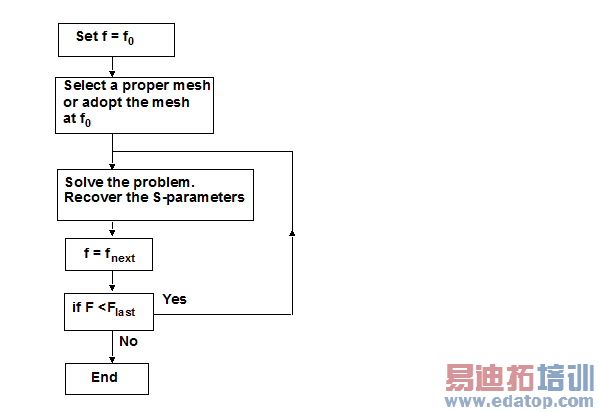
The procedure for a Discrete frequency sweep is shown below, where n equally spaced frequencies are included in the sweep.
HFSS 学习培训课程套装,专家讲解,视频教学,帮助您全面系统地学习掌握HFSS
上一篇:Discovering Methods
下一篇:Discussion of HFSS Distributed Memory Solutions